
What Is a Sustainable Corporate Christmas Gift in the UK?
A sustainable corporate Christmas gift in the UK is a present a company sends to staff or clients that can still be explained in January: who made the things inside, what those products fund, how the parcel was packed, and why it did not feel like a logo tin with a seasonal sticker. Social Stories Club is the Edinburgh company that makes sustainable gift boxes and gift hampers in that shape, with UK social enterprise products and a story booklet in the parcel so the person opening it does not have to take the website on trust.
Christmas is when that definition either holds or falls apart, usually because the brief is late, the list is longer than anyone admitted in October, and somebody still wants it to feel like a gift. The rest of this is about that month, not about restating what a social enterprise is until the decorations go up.
What is the actual Christmas brief?
Most teams are trying to do four jobs at once. They want to say thank you in a year when a lot of people have been working from kitchens and spare rooms. They want a budget that finance will recognise, which sometimes means under £50 a head, sometimes means £50 exactly, and sometimes means more than that because the company has decided the gift is allowed to be generous. There is no single correct number. There is only the number you can defend and the gift that still feels like a present at that number.
They also want the vegans, the gluten-free people and the person with the serious allergy to be treated as part of the list rather than a problem discovered on the 18th. And they want the thing to arrive at a home address in a week when half the office is already off, without the recipient opening an invoice and feeling as though they have been handed a delivery note instead of a present.
If your hamper cannot do those jobs, it does not matter how many times the word sustainable appears on the card. Christmas gifts fail in operational ways. They are late. They are identical to the tin from the year before. They exclude someone on the list. They look like procurement.
What should be in it?
The useful Christmas test is whether a normal person can name a maker after they have eaten the first biscuit. Tea linked to education, chocolate linked to trees or to women rebuilding a life after prison, bath products tied to supported employment, food made with surplus ingredients or renewable energy: those are the sorts of products that go into a Social Stories Club hamper. The mix changes through the year because makers come in and out, which is inconvenient for anyone who wanted a permanent contents list and honest for anyone who would rather the range stayed alive.
The booklet is how the recipient finds out what they are holding without being sent away to a campaign page they will never open. Take the booklet out and you still have a Christmas box. You no longer have a gift anyone can explain to the person standing next to the kettle, which is the whole point of using social enterprises in the first place.
A gift box in a biodegradable carton printed with “This Box Supports Different Social Causes” is the one that gets through a front door and sits on a kitchen table. A gift hamper in a reusable paper-rope basket, packed with wood-wool rather than plastic peanuts, is the one that looks like you meant it. For a long home-delivery list the box is usually the less ridiculous object to carry up the stairs. For a smaller client list the hamper is the one that does the occasion. The ethics are in the makers and the booklet. The container is for Christmas logistics.
A Christmas order that shows the brief more clearly than a theory
One year a company asked us to send 161 boxes to individual addresses across the UK. They did not pick one hamper and hope. They offered staff three options: a box full of food, drink and chocolate; a very similar box that was vegan; and a third option made mainly of reusables, with no food or drink in it. People chose A, B or C for themselves.
What they found is the bit worth stealing. The vast majority wanted food and drink. The company had been close to ordering the vegan box for everyone, which would have been tidy, inclusive on paper, and wrong for most of the list. A bit of choice meant people felt they were getting something they actually wanted, and the vegan box still existed for the people who needed it. The reusable option existed for the people who did not want another edible gift in a house that already had too much of it.
That is the difference between a sustainable corporate Christmas gift and a sustainable corporate Christmas theory. Choice is not a nice extra. It is how you stop a well-meant decision in a meeting becoming 161 identical parcels that miss.
When does “in time for Christmas” actually mean?
A straightforward UK website order is usually with people a couple of working days after it is dispatched. That clock is for a ready-made box with a clear address, not for a branded run, an extra page in the booklet about your company, or a spreadsheet of 161 home addresses with three variants on it. Those orders need a proper lead time, and November is when that conversation is still a conversation. The second week of December is when it becomes a rescue.
Social Stories Club does not pretend that every format leaves on the same day. If you have a date the gifts must arrive by, ask for this year’s last packing day for your format before you get attached to a particular basket. Ready-made pre-curated gifts are how you protect that date when the list is simple. Corporate hampers are how you handle the list that will not fit in a comments box. Mainland UK delivery is carbon-neutral. The date that matters is the day your actual order can be packed, not the day the idea first came up in a meeting.
Hybrid teams make this harder than it used to be. A single pallet to reception only works if reception is staffed and if the people you are thanking will be in the building to collect it. Home addresses mean someone has to clean the list, and they have to do it before the packing bench is already full of other people’s Christmas.
Food rules are not a festive extra
Everything goes out vegetarian unless you say otherwise. If the brief is vegan, it needs a vegan gift or a build-your-own selection chosen that way from the start, not a standard hamper with one item quietly swapped after the labels are printed. Gluten-free and other requirements are possible if they are on the order before packing.
The 161-box order is the warning against flattening everyone into one diet because it is simpler to administer. Offer the vegan option. Do not assume it is the option. Orders are packed in a space that also handles other allergens. A severe allergy is not a note for the courier. It is a note for the first email.
Choosing the contents, or deciding not to
Build your own is there for the buyer who knows the recipients, or for the buyer who has been asked to account for every item because someone in procurement likes a list. You choose the treats, we pack them with the booklet and the note, and the price stays off the gift. That last part matters more at Christmas than people admit, because a present with a packing slip in the lid is no longer a present.
If you do not want to choose every biscuit, that is not a failure of taste. Letting staff choose between two or three finished options is often the better kind of control. Ready-made boxes exist so you can spend the remaining time on names and addresses, which is where corporate gifts usually break. The companies that look organised in the first week of December are rarely the ones who curated every item themselves. They are the ones who locked the format in November and then refused to reopen it.
Is this the same as an eco hamper or a branded tin?
No. An eco hamper can be recycled ribbon and a photograph of some leaves. A branded tin is your logo doing all the work. A social enterprise Christmas gift has to answer who made this, what it funds, whether the recipient can read that without a QR-code treasure hunt, and whether the company that made the hamper is a social enterprise itself.
“Social enterprise” is not a protected legal term in the UK, which is why the phrase travels so easily in November. A limited company can use the words. A limited company can even put one mission-led bar in a conventional box and describe the whole parcel as a social enterprise hamper. That bar can still be worth choosing. It does not turn the gifting company into a social enterprise. Social Stories Club is operated by Kaleidosocial CIC, which is the unglamorous version of the last answer. If you need hours of work, money going into the social enterprise economy, trees planted, look at the impact report rather than expecting a Christmas blog to double as an audit.
David Adair at PwC called Social Stories Club “the perfect way to buy gifts with a social impact.” The Jamie Oliver Group said their staff welcomed the gift and liked learning what the company does. In December I would rather have that reaction than another paragraph about the planet.
How to brief one without turning the month into admin
Write the diets down first, including the people who will be offended if you guess, and decide whether you are offering one box or a small menu. Decide box or hamper next, on the basis of doorsteps and desk space rather than which photograph looks more abundant. Give us the addresses in one list, home or office stated, while the names are still stable. If you need branding or a line in the booklet about your company, say that before you pick a dispatch week. Book a call if the spreadsheet is already a personality.
A sustainable corporate Christmas gift in the UK earns the name when someone can still explain it after the decorations are down. If the answer depends on a landing page they will never open, choose a different parcel. Social Stories Club makes those boxes and hampers so the explanation is already inside when it arrives.
Follow Social Stories Club on Social Media
Read More From Our Blogs For Corporates
What Makes a Sustainable Client Christmas Gift in the UK?
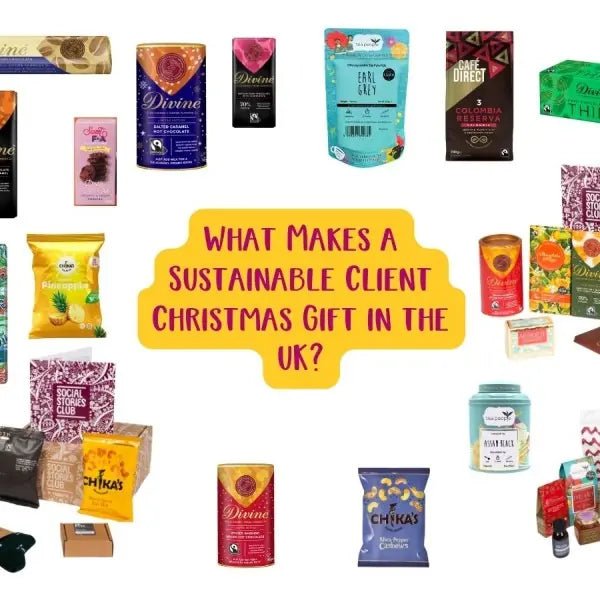
A sustainable client Christmas gift in the UK is a present a company sends to the people it works with that still feels like a gift in December.

Gift Box or Gift Hamper: How to Choose a Social Enterprise Gift
A social enterprise gift box or gift hamper is a present filled with products from social enterprises, with enough written explanation about the good it does.

Team Christmas Gift or End-of-Year Bonus?
If you are weighing a team Christmas gift against an end-of-year bonus, it helps to treat them as two different gestures.

Ethical Corporate Gifts UK: Social Enterprise Hamper vs Branded Merch vs a Voucher
Compare ethical corporate gifts in the UK: a social-enterprise hamper, branded merch, or a voucher. What each signals and when to use which.

Social Stories Club Corporate Gifting
If you are looking to show your team how much they are appreciated, attract and retain clients, or you have a corporate event and you want to create an impression, then our sustainable corporate hampers are just what you need. We have created the most exciting gift to give and receive which are packaged beautifully using sustainable materials, filled with delicious products made by social enterprises, and also include a storybook starting conversations about sustainability.
"Social Stories Club is a fantastic initiative that enables social enterprises to collaborate in such a creative way. The perfect way to buy gifts with a social impact" - David Adair, Head of Community Engagement, PwC