
Build Your Own Gift Hamper or Ready-Made: How Teams Actually Choose
Ready-made, on the Social Stories Club site, means the contents are already chosen and you order the box or hamper as it stands. Build-your-own means you choose the treats that go in. Staff choice means the people receiving the gift pick for themselves, either from two or three finished options or on a page built for them, where they can place the order and type their own address. Social Stories Club makes all three in Edinburgh, and there is no minimum on build your own, which is the fact most team briefs get wrong.
The useful question is not which format sounds more personal. It is who should decide what is in the parcel, and how that decision gets from a meeting into 11 boxes or 161.
Ready-made vs build-your-own vs staff choice
Ready-made | Build-your-own | Staff choice | |
|---|---|---|---|
Who picks the contents? | Social Stories Club, already on the website | You, item by item | The recipient, by survey or a custom page |
Live prices | Varies by line on the hamper collection | Same, depending on the options you put on the menu | |
Minimum order | No minimum on pre-curated lines | No minimum | No minimum |
When it is the right tool | The date is real and you do not know the recipients well | A small team that cares what is inside, or procurement wants a list | A mixed list you were about to flatten into one diet |
What still comes in the parcel | Booklet, note if you want one, no price in the gift | Same booklet, including a reusable no-food option | Same booklet on every option |
What is a ready-made Social Stories Club gift?
Ready-made is anything already on the site with the contents selected: pre-curated gifts and the main gift box and hamper range. You are not inventing a product. You are ordering one that exists, adding a personal message if you want one, and telling us where it is going.
That is the right tool when the delivery date is the thing that can fail. A straightforward UK website order is usually with people a couple of working days after dispatch. That clock holds when you have not asked for a new box for each department. Ready-made is how a Christmas list stays a Christmas list.
What is a build-your-own gift box or hamper?
Build-your-own is where you choose the treats. On the current range, gift boxes run from 4 treats at £26 up to 15 treats at £82. Hampers run from 6 treats at £51 up to 15 treats at £108. You can add a personal message. The story booklet still goes in. A reusable option with no food or drink is still a Social Stories Club gift hamper and still gets the same booklet.
There is no minimum. One box is an order. Eleven boxes are an order. A hundred and sixty-one boxes are an order. Branding and a custom page are a different conversation. Build-your-own itself does not start at fifty units.
Martin buys build-your-own boxes for eleven staff every year. It is a small order on purpose. The staff like choosing what is in their hamper, and they get to do that every year rather than receiving the same safe selection someone picked once and never revisited. If you have been told team gifting only counts when it is large, that is a branding rule being applied to the wrong product.
How do staff choose what they get?
There is not one method. Sometimes the company sends a survey: option A, B or C, reply by this date. Sometimes Social Stories Club builds a custom page on the website for that client, and each person orders their own gift and types their own address. Sometimes the buyer builds the boxes, like Martin. Sometimes the recipient goes onto the ordinary ready-made or build-your-own pages and the company is only paying.
Alice’s order was 161 boxes to individual addresses across the UK. Staff had three finished options: one full of food, drink and chocolate; a very similar vegan version; and a reusable option with no food or drink. People chose A, B or C. The vast majority wanted food and drink. About ten percent of people, in our experience, take the vegan box when they are given a real choice. Alice’s company had been close to ordering vegan for everyone because it looked like the safest single decision. Letting people pick stopped that tidy mistake, and the vegan box still existed for the people who needed it.
Personal messages can sit alongside staff choice. What you want is a point at which the contents are agreed, so Alice’s 161 boxes and Martin’s eleven can both leave as the order you briefed.
What should you bring to a conversation about custom gift boxes?
None of this is essential before a call. It is simply useful if you already know:
- How many people it is for.
- The budget per person, whatever that number is.
- Where the parcels are going: which country, one office, or separate addresses.
- Dietary requirements you actually know about.
- The sorts of products you want in the gift, including whether anyone would rather have no food.
- Whether you want custom branding and personalised notes.
- The date you want the hampers there by.
If you do not have all of that, the conversation can still happen. The list is what stops the meeting becoming a guessing game.
How should you decide which route to use?
If you can name a hard delivery date and you cannot name the recipients as people, choose ready-made, or give them two or three finished options. If you can picture the eleven people and they care what is in the box, build-your-own, the way Martin does. If you were about to flatten a mixed list into one diet because it was simpler to administer, stop and offer a short menu, the way Alice did.
Write diets down before you look at photographs of baskets. Everything we send is vegetarian unless you say otherwise. Vegans need a vegan gift or a build-your-own selection chosen that way from the start. About one in ten people take that option when they can choose. The other nine will notice if you chose it for them. Orders are packed in a space that also handles other allergens, so a severe allergy belongs in the first email.
Box or hamper is a doorstep question. Boxes in a biodegradable carton travel more kindly to individual UK addresses. Hampers in a reusable paper-rope basket look more like an occasion when there are fewer of them. For 161 home addresses, the box is usually the less ridiculous object on a doorstep. For eleven people you see every week, either format can be the gift.
What helps a team order go the way you meant it to
The work that makes the gift feel considered is mostly quiet. Addresses in one list, home or office stated, while the names are still stable. A reply-by date if staff are choosing, so the custom page or the survey can close before packing is planned. Diets written down early, including the vegan option that about one in ten people take when they can choose, and any severe allergy in the first email rather than the last.
Personal messages can sit next to staff choice. What you want is a point at which the contents are agreed, so Alice’s 161 boxes and Martin’s eleven can both leave as the order you briefed. If the list is already long enough that a comments box feels silly, use the corporate hamper page or book a call and bring the seven points above if you have them.
Ready-made, build-your-own and staff choice are three ways of getting a Social Stories Club gift to a team. The only decision that matters is who is allowed to care what is inside it.
Follow Social Stories Club on Social Media
Read More From Our Blogs For Corporates
The Substantial Sustainable Gift Guide: Hampers and Boxes People Actually Remember
Most gift guides list a price and a couple of items and leave you to guess whether it will actually land. This one tries to do the opposite.
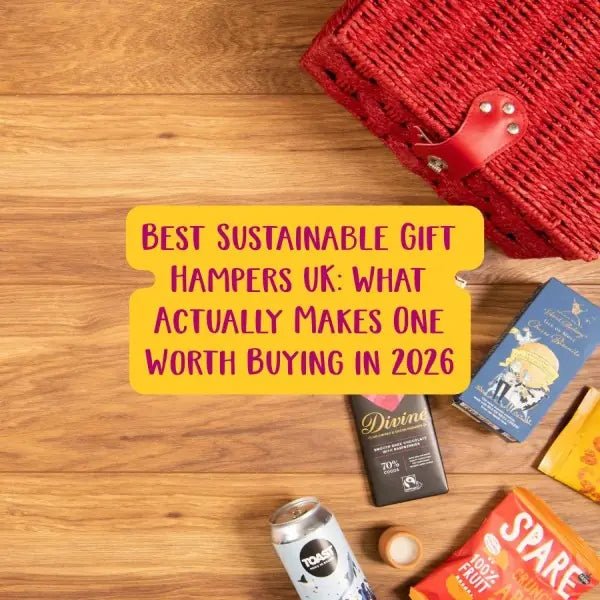
Best Sustainable Gift Hampers UK: What Actually Makes One Worth Buying in 2026
I still remember the first time someone emailed us, saying they had looked up one of the social enterprises while they were eating the chocolate in their gift.
What Is a Vegan Social Enterprise Gift Hamper in the UK?
A vegan gift hamper in the UK, when Social Stories Club makes it, is a gift with no animal products in the contents, packed with products from social ventures.
Sustainable Gift Hamper UK: What to Buy
Looking for a sustainable gift hamper in the UK? Choose social-enterprise products, a story booklet and carbon-neutral delivery. Here is what to buy.

Social Stories Club Corporate Gifting
If you are looking to show your team how much they are appreciated, attract and retain clients, or you have a corporate event and you want to create an impression, then our sustainable corporate hampers are just what you need. We have created the most exciting gift to give and receive which are packaged beautifully using sustainable materials, filled with delicious products made by social enterprises, and also include a storybook starting conversations about sustainability.
"Social Stories Club is a fantastic initiative that enables social enterprises to collaborate in such a creative way. The perfect way to buy gifts with a social impact" - David Adair, Head of Community Engagement, PwC